

Pig-to-Human Liver Xenotransplantation
Pig-to-Human Liver Xenotransplantation: A New Milestone in Transplant Medicine

A New Step Forward in Liver Xenotransplantation
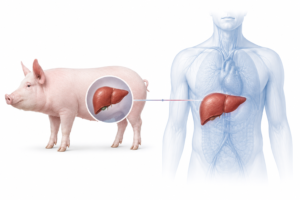
Organ shortage remains one of the major challenges in transplant medicine. Every year, many patients with advanced liver disease cannot receive a transplant in time because of the limited availability of human donor organs. In this context, xenotransplantation, the transplantation of organs, tissues or cells between different species, is attracting growing scientific attention. A study published in the Journal of Hepatology reports a major step forward in this field: the first auxiliary liver xenotransplantation from a genetically modified pig to a living human recipient. This clinical case does not yet represent a widely applicable therapeutic solution, but it provides important proof of concept that a genetically engineered porcine liver can support key liver functions in humans.
A patient with advanced liver disease
The case involved a 71-year-old man with hepatitis B-related cirrhosis and hepatocellular carcinoma. According to the authors, the patient was not eligible for surgical resection or human liver transplantation. Given this complex clinical situation, the medical team performed an auxiliary xenotransplantation. Unlike conventional liver transplantation, this approach involves implanting an additional graft without fully removing the patient’s native liver. The aim is to allow the graft to support essential hepatic functions.
A genetically modified porcine liver
The graft came from a genetically modified Diannan miniature pig. Ten genetic modifications were performed to improve compatibility between the porcine organ and the human recipient. These modifications included the knockout of specific xenoantigens, which are involved in immune reactions against tissues from another species, as well as the insertion of human transgenes. The objective was to reduce the risk of rejection and improve compatibility with human coagulation mechanisms.
Liver function observed during the first month
After surgery, the graft showed signs of function. During the first month, the authors reported bile production and synthesis of coagulation factors. No evidence of hyperacute or acute rejection was observed during this initial period. These findings suggest that, under experimental conditions, a genetically modified porcine liver may be able to provide key metabolic and synthetic functions in a living human recipient.
Significant complications remain
Despite these encouraging results, the patient’s clinical course also highlighted the current limitations of this approach. On day 38, the graft had to be removed after the development of xenotransplantation-associated thrombotic microangiopathy, a serious complication linked in particular to complement activation and endothelial injury. This complication was treated with the complement inhibitor eculizumab and plasma exchange. The patient later experienced repeated episodes of upper gastrointestinal bleeding and died on day 171.
A scientific milestone, not yet a routine clinical solution
This study represents an important milestone in hepatology and transplant medicine. It shows that a genetically modified porcine liver can engraft and temporarily contribute to key hepatic functions in a living human recipient. However, it also underlines the major challenges that must still be addressed before broader clinical application can be considered: immune response control, prevention of coagulation disorders, management of vascular complications, long-term safety and ethical considerations. In a global context of organ shortage, xenotransplantation may one day become a complementary pathway for selected patients awaiting therapeutic options. At this stage, however, it should be considered an experimental approach that remains under evaluation.
Why this breakthrough matters for transplantation
Liver transplantation currently relies mainly on the availability of human donor organs. Yet demand continues to exceed supply. Research into xenotransplantation therefore aims to explore new ways of addressing this critical unmet need. This first auxiliary pig-to-human liver xenotransplantation in a living recipient does not answer all remaining questions, but it marks a significant scientific milestone. It reflects the rapid progress being made at the crossroads of transplant surgery, genetic engineering, immunology and regenerative medicine. For stakeholders involved in organ transplantation, this publication highlights the importance of monitoring scientific innovation with accuracy, caution and clarity. It opens new perspectives for the future of transplantation, while reminding us that patient safety and clinical validation remain essential before any change in medical practice.
This article is intended for scientific information purposes only and summarizes the findings reported by the authors. Xenotransplantation remains an experimental field and is not presented here as a routine clinical solution.
Source
This article is based on the scientific publication:
Zhang W. et al. Genetically Modified Porcine-to-Human Liver Xenotransplantation. Journal of Hepatology. DOI: 10.1016/j.jhep.2025.08.044.
Full article here.
This article is brought to you by IGL as part of its scientific news sharing.