

DHOPE for Daytime Transplantation
Prolonged DHOPE and Daytime Liver Transplantation: Improving Surgical Logistics

Extending Liver Preservation to Support Daytime Transplantation
Liver transplants are performed around the clock, often creating substantial logistical challenges for patients, clinicians, and transplant programs. In this context, extending graft preservation time in a controlled way may offer greater flexibility in planning liver transplant procedures. A study published in JAMA Network Open evaluated the use of DHOPE-PRO, or prolonged dual hypothermic oxygenated machine perfusion, to facilitate daytime liver transplantation. The aim was to assess whether this strategy was associated with an increased proportion of daytime liver transplants, without compromising graft or patient outcomes.
What is DHOPE-PRO?
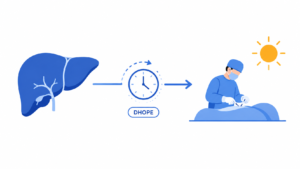
DHOPE stands for dual hypothermic oxygenated machine perfusion. It is an ex situ perfusion method that preserves the donor liver at low temperature, around 10 °C, with active oxygenation through both the portal vein and the hepatic artery. Short-duration DHOPE, usually performed for 1 to 2 hours before transplantation, is used to mitigate ischemia-reperfusion injury. According to the article, randomized clinical trials have shown that this approach can reduce transplant-related complications, including biliary complications, early allograft dysfunction, and postreperfusion syndrome. DHOPE-PRO follows the same principle, but with a prolonged perfusion duration. Its purpose is to extend liver preservation time and enable better planning of the transplant procedure.
Why focus on daytime liver transplantation?
The article highlights that liver transplants may be performed at any time of day or night. This can create important organizational constraints for surgical and clinical teams. In this study, the authors assessed whether routine use of DHOPE-PRO could shift liver transplantation toward daytime hours. Daytime transplantation was defined as surgery starting at or after 8 am, with either reperfusion occurring before 8 pm or the procedure being completed before midnight. The central focus of the study was therefore not only biological graft preservation, but also surgical logistics: how to extend preservation in a controlled way to make transplant timing more predictable.
A prospective study conducted in the Netherlands
This was a prospective cohort study conducted at a large academic liver transplant center in the Netherlands. The authors compared two periods. The first period, from 2021 to 2022, included liver transplants performed before routine implementation of DHOPE-PRO. The second period, from 2023 to 2024, included liver transplants performed after routine implementation of DHOPE-PRO. A total of 330 liver transplants were analyzed: 155 in the 2021-2022 cohort and 175 in the 2023-2024 cohort. Grafts came from donation after brain death, donation after circulatory death, or living donors. Follow-up continued until December 31, 2025, ensuring at least 1 year of follow-up for each patient.
A major increase in daytime liver transplants
After implementation of DHOPE-PRO, the proportion of daytime liver transplants increased markedly. Daytime reperfusion increased from 48.4% of cases in 2021-2022 to 84.6% in 2023-2024. Similarly, the proportion of procedures completed during daytime hours increased from 53.5% to 89.1%. These findings show that routine use of DHOPE-PRO was associated with a major shift in surgical timing, with more liver transplants performed during daytime hours.
Extended preservation time
The study also showed that the median duration of DHOPE increased after DHOPE-PRO implementation. It rose from 2.1 hours in the 2021-2022 cohort to 10.2 hours in the 2023-2024 cohort. The median total machine perfusion time increased from 7.8 hours to 14.3 hours. Median total preservation time increased from 9.3 hours to 18.6 hours. In this study, total preservation times reached up to 31.4 hours. The authors also reported maximum DHOPE durations of 20.5 hours for DBD grafts and 23.8 hours for standard DCD grafts.
A strategy adapted to graft type
The study distinguished several graft types and preservation strategies. Donation after brain death grafts, known as DBD grafts, could be transplanted without machine perfusion or placed on DHOPE-PRO depending on logistical and clinical factors. Standard donation after circulatory death grafts, known as DCD grafts, underwent either short-duration DHOPE or DHOPE-PRO depending on time of arrival. Extended criteria DCD grafts required viability assessment. They underwent DHOPE or DHOPE-PRO, followed by controlled oxygenated rewarming and normothermic machine perfusion to assess graft viability before transplantation.
Comparable clinical outcomes in this study
One of the important findings of the article is that DHOPE-PRO use was not associated with increased post-transplant complications. The authors reported no significant differences in intraoperative parameters, including operation duration, blood loss, transfusion requirements, or incidence of postreperfusion syndrome. Postoperative intensive care unit stay and hospital length of stay were also comparable between groups. Early postoperative ALT and AST levels were largely similar, and peak ALT and AST levels did not correlate with DHOPE preservation duration. DHOPE-PRO use was not associated with new-onset acute kidney injury or new-onset renal replacement therapy.
Graft survival and patient survival
In this study, graft and patient survival at 6 and 12 months were similar across the different subgroups. Overall 1-year patient survival was at least 90% in all subgroups. The authors’ multivariable analyses indicated that DHOPE-PRO use was not associated with either graft survival or patient survival. This point should be interpreted carefully. The study does not show that DHOPE-PRO improves survival. Rather, it shows that DHOPE-PRO was associated with improved surgical logistics while maintaining comparable clinical outcomes in the studied cohort.
Added flexibility in complex situations
The article also describes several situations in which DHOPE-PRO provided additional logistical flexibility. The authors mention pediatric cases, split-liver transplantation, combined heart-liver or lung-liver transplantation, and a case in which a donor liver had to be reallocated after an unforeseen change in recipient. In these situations, prolonged preservation allowed the graft to remain on DHOPE-PRO until transplantation, avoiding additional ischemic injury.
Study limitations
The authors note several limitations. First, this was a single-center study. Although implementation was structured and data collection was systematic, external validation is still required. Second, DHOPE-PRO was applied for up to 24 hours, with total preservation times reaching 31.4 hours, but the optimal and maximal safe durations remain unknown. Finally, the current follow-up period did not allow evaluation of biliary complications beyond 12 months, immunological rejection, or patient-reported outcomes. The authors indicate that future multicenter studies with longer follow-up are needed to assess the long-term safety, efficacy, and generalizability of this approach.
What this study brings to liver transplantation
This study shows that routine implementation of DHOPE-PRO was associated with a major increase in the proportion of liver transplants performed during daytime hours. It also suggests that controlled extension of liver preservation time may improve surgical logistics without compromising the clinical outcomes observed in this cohort. The authors conclude that DHOPE-PRO is a promising organ preservation strategy to facilitate daytime liver transplantation. These findings support its potential for broader clinical application, while highlighting the need for external validation and longer follow-up. This article is intended for scientific information purposes only and summarizes the findings reported by the authors. DHOPE-PRO is presented here based on the results of this prospective cohort study and should be interpreted within the context and limitations of the study.
This article is intended for scientific information purposes only and summarizes the findings reported by the authors. DHOPE is presented here based on the results of this randomized trial and should be interpreted within the context and limitations of the study.
Source
This article is based on the scientific publication:
Long-term Follow-up After Hypothermic Oxygenated Machine Perfusion in DCD Liver Transplantation: Results of a Randomized Controlled Multicenter Trial (DHOPE-DCD), published in Annals of Surgery. DOI: 10.1097/SLA.0000000000006876.
Full article here.
This article is brought to you by IGL as part of its scientific news sharing.